Top
New York  London  GMT  Tokyo  Sydney 

Solving the magnitude of the euro short squeeze

By   || February 3, 2012 at 18:22 GMT
|| 9 comments || Add comment

In about two hours, the CFTC will release its weekly positioning data in the Commitments of Traders report. It’s almost a slam dunk that EUR speculative shorts will diminish from a record -171K.

The data covers up to the close on Feb 1 but the euro at the same level as it was then, so it should give us a good idea how much has been squeezed out of the ‘short euro’ trade.
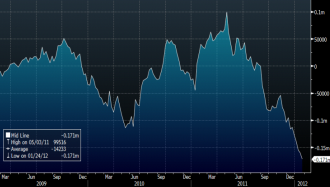
Recently, a 50K move is almost unheard of but I expect a rebound to about -120K.

GBP, at -31K, could climb to nearly flat.

Anything significantly less than that indicates that the squeeze still has some room to go.

Share and Enjoy:
  • RSS
  • Facebook
  • Twitter
  • LinkedIn
  • email
  • Print
  • Add to favorites
  • del.icio.us
  • Digg
  • NewsVine
  • StumbleUpon

Add a comment

9 Responses to “Solving the magnitude of the euro short squeeze”

  1. Tony on February 3rd, 2012 18:33 GMT

    If the Greek PM gets the boot tonight then things will change quite fast as Greece will default – hard default

  2. Rance on February 3rd, 2012 19:03 GMT

    Hi Adam, can you clarify for me your posting, i.e., “… squeezed out of the ‘short euro’ trade.” Do you mean that shorts are covering? And on the rebound to -120K does this imply that the E/U will have Longs trying to push toward 1.32+?

    Thanks for any feedback for us newbies…

  3. Adam Button on February 3rd, 2012 19:10 GMT

    I can appreciate if it’s a bit confusion. Everyone was short euro and with the rebound, shorts were forced to cover. If there is a rebound to -120K, it still shows that the market is massively short… but less so. Think of those shorts covering as the fuel for the euro rally. As -171K falls to -120K and toward zero, it means there is less fuel for the rally.

  4. Rance on February 3rd, 2012 19:35 GMT

    Thanks Adam, got it. So I presume that at some point and depending on the Greek situation we will have a fall back toward the 1.30 level and possibly lower as some suggest.

  5. lumesh on February 3rd, 2012 19:42 GMT

    well, i wouldn’t bet on it…There actually hasn’t been any real squeeze yet. Markets move in a similar manner. Look back into oct of 2011…Eur moved up ca 700 points from the bottom and then consolidated around 2 weeks at the previous high of 15th Sept 2011. Now look at the COT in the same period: despite the heavy 700 point move up, non-comm positions didn’t really change. It was, in fact the NEXT push up that did some position squeezing (COT wise anyway)…RIght now, the same play is in the cards…we are up around 600 points at around the previous high of 21st of Dec 2011…we’ve seen some decent consolidation recently and you can be sure that there are some decent stops above the range high. Could the catalyst be the Greek deal over the weekend ? I don’t really know…noone does…some say deal’s been priced in but in my experience events like those can still cause this squeeze. Especially when we think about a traders behaviour. See, so far, we have been grinding higher from a (technically seeming) downtrend. Now, everyone is bearish eur anyway so this looks to be the perfect place to sell into it in the expectation that the current trend will continue. Whether the reasoning is downward sloping trendline or a fib retrancement or whatever…So, IMO, noone, SO FAR, has had a REAL reason to be squeezed. It’s when this current range gets killed to the upside you might see squeezing…

  6. Henrik on February 3rd, 2012 20:14 GMT

    Hi Adam,

    Can ECB extend it’s balance sheet and also take on losses (from e.g. Greece) without any down-grade from rating institutes? As ECB represent all EZ-banks (good and bad sovereigns) some taxpayers have to stand the risk as well as non-EZ zone central banks plus BIS….but is the creditworthness unlimited?
    Please reply as interesting/important

  7. Adam Button on February 3rd, 2012 20:19 GMT

    With the ECB it’s not about the ratings agencies. It doesn’t issue debt so it doesn’t have a rating. It issues currency and the EUR is it’s rating. The treaty prohibits the ECB from taking losses so the chance of a loss is nil. The question is: will the forego profits?
    If the ECB took on a pile of debt (like Greece) and there was a true default, it’s assumed that the ECB would still be paid.

    To the spirit of your question, is the creditworthiness unlimited? yes, but as the balance sheet grows, the euro falls.

  8. Henrik on February 3rd, 2012 21:10 GMT

    Thanks a lot, Adam!

  9. Bjorn on February 3rd, 2012 22:24 GMT

    Excellent analysis lumesh.

Bottom